Introduction
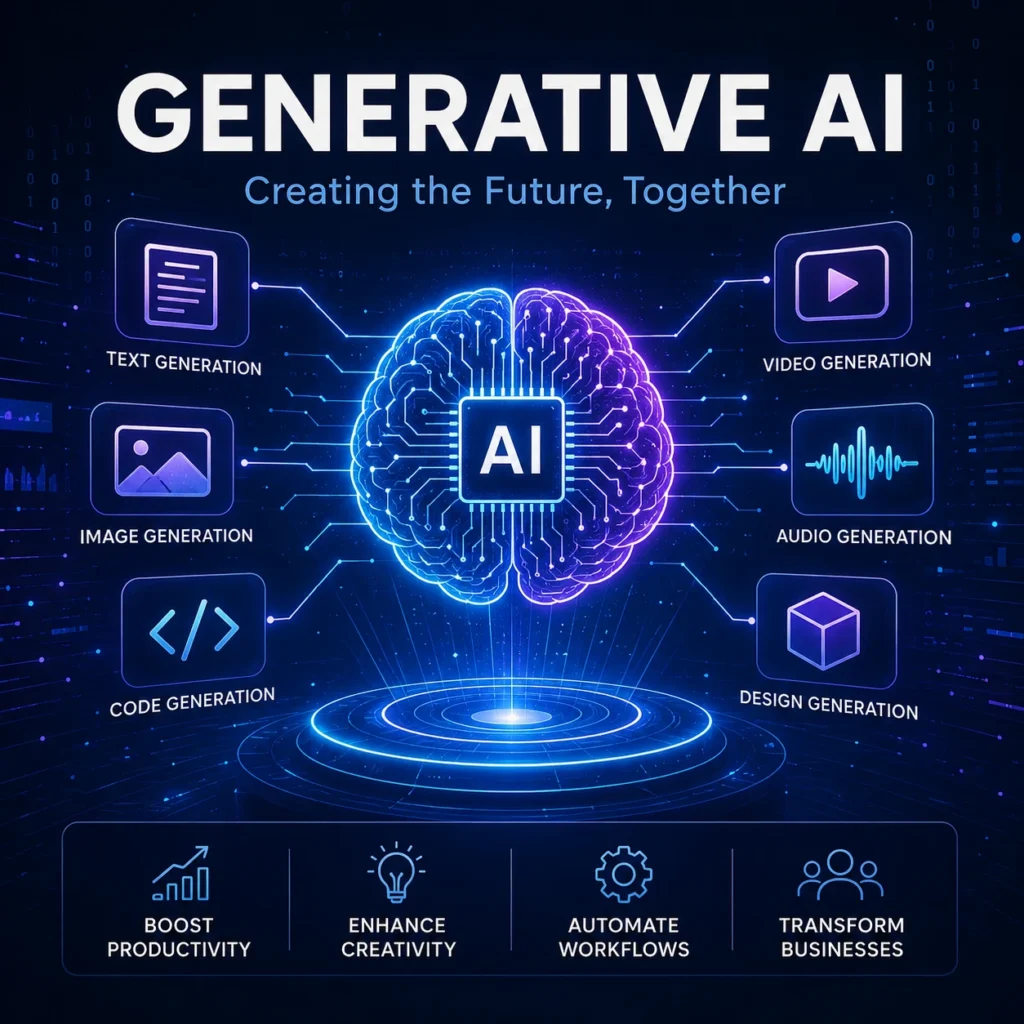
Artificial Intelligence (AI) is reshaping how businesses operate, innovate, and serve customers. Among the most transformative advancements in AI is Generative AI—a technology capable of creating entirely new content, including text, images, videos, code, music, and even product designs.
Generative AI is no longer a futuristic concept. It is actively transforming industries such as healthcare, finance, manufacturing, retail, education, and marketing. Businesses using Generative AI are improving productivity, reducing operational costs, accelerating innovation, and enhancing customer experiences.
In this guide, we explain what Generative AI is, how it works, its benefits, challenges, and why it matters for businesses in 2026.
What Is Generative AI?
Generative AI refers to a category of artificial intelligence models designed to generate new content based on patterns learned from massive datasets.
Unlike traditional AI systems that analyze or classify existing data, Generative AI can create original outputs.
Examples include:
Writing articles, reports, and emails
Generating realistic images and graphics
Creating videos and animations
Producing software code
Designing products or prototypes
Generating voice, music, and audio content
Popular examples include tools developed by OpenAI, Google AI, Microsoft AI, and Anthropic.
How Does Generative AI Work?
Generative AI models are trained on enormous volumes of data such as:
Text documents
Images
Audio recordings
Videos
Code repositories
Structured business data
These models learn patterns, relationships, context, and probabilities between data points.
When a user provides a prompt such as:
“Create a marketing campaign for a wellness brand”
The AI predicts the most relevant output based on its training and generates content accordingly.
Key technologies powering Generative AI include:
1. Large Language Models (LLMs)
LLMs are trained on massive text datasets to generate human-like text.
They power:
2. Neural Networks
Neural networks mimic how the human brain processes information and identifies patterns.
3. Transformers
Transformers enable AI to understand context, meaning, and long-range relationships in data.
This breakthrough significantly improved language and content generation.
Types of Generative AI
Text Generation
Used for:
Blogs
Reports
Product descriptions
Emails
Customer support replies
Image Generation
AI can create:
Product visuals
Social media graphics
Marketing creatives
Interior concepts
Brand designs
Video Generation
AI can generate:
Explainer videos
Advertisements
Training videos
Presentations
Audio Generation
Used for:
Voice assistants
AI voiceovers
Music creation
Podcast automation
Code Generation
Developers use AI to:
Write code
Debug software
Generate scripts
Speed up development
Benefits of Generative AI
Increased Productivity
Teams can automate repetitive tasks and focus on strategic work.
Faster Decision-Making
AI helps analyze large datasets quickly and provide insights.
Reduced Costs
Automation lowers operational expenses.
Better Customer Experience
AI chatbots offer instant and personalized support.
Faster Innovation
Businesses can prototype ideas rapidly.
Real-World Business Applications
Generative AI is transforming nearly every industry.
Healthcare
Applications include:
Medical documentation
Drug discovery
Diagnostic support
Patient communication
Relevant field: Healthcare Informatics
Retail & E-commerce
AI helps with:
Finance
Use cases include:
Manufacturing
AI supports:
Marketing
Generative AI improves:
Ad copy creation
Campaign planning
SEO content generation
Graphic design
Challenges of Generative AI
Despite its benefits, Generative AI comes with challenges.
Data Privacy Risks
Sensitive data must be handled securely.
Accuracy Issues
AI can occasionally generate incorrect information.
Bias
AI models may reflect biases present in training data.
Compliance
Businesses must follow regulatory and ethical guidelines.
Security
AI systems must be protected against misuse.
Generative AI vs Traditional AI
| Feature | Traditional AI | Generative AI |
|---|
| Purpose | Analyze data | Create new content |
| Output | Predictions | Text, images, videos |
| Use Case | Detection, automation | Creation, innovation |
| Flexibility | Limited | High |
Why Generative AI Matters in 2026
In 2026, Generative AI is becoming a major competitive advantage.
Organizations adopting AI early are:
Businesses that ignore AI risk falling behind competitors.
Generative AI is no longer optional for future-focused companies.
How Jisoteix Helps Businesses with AI
At Jisoteix Technologies LLP, we help organizations implement AI-driven solutions that improve efficiency, automation, and decision-making.
Our AI capabilities include:
We help businesses turn AI from a concept into measurable growth.
Final Thoughts
Generative AI is revolutionizing the way businesses create, operate, and compete.
From content generation and automation to product innovation and customer engagement, the impact of Generative AI is massive and growing rapidly.
Companies that strategically adopt AI today will be better positioned for long-term success in tomorrow’s digital economy.
The future of business is increasingly AI-powered—and Generative AI is leading that transformation.