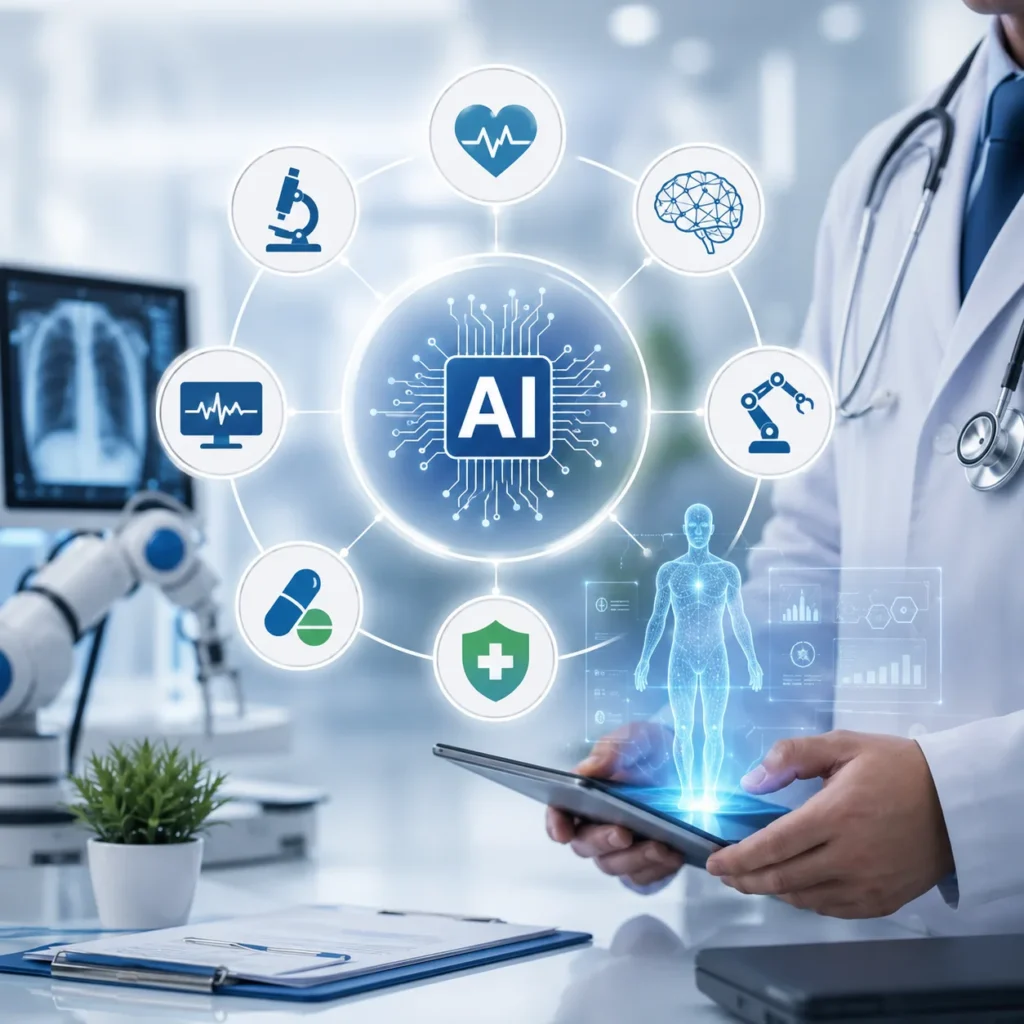
Smarter Healthcare. Better Outcomes.
Introduction
Artificial Intelligence (AI) is rapidly transforming the healthcare industry by making medical services more accurate, efficient, and patient-centric. From assisting doctors in diagnosing diseases to automating hospital operations, AI is helping healthcare providers improve patient outcomes while reducing costs and administrative burdens.
As healthcare organizations continue their digital transformation journey, AI has become an essential technology for delivering smarter care, optimizing workflows, and supporting data-driven decision-making. Whether it’s a hospital, diagnostic center, pharmaceutical company, or healthcare startup, AI is creating new opportunities to improve both clinical and operational performance.
What is AI in Healthcare?
AI in healthcare refers to the use of advanced technologies such as machine learning, natural language processing (NLP), computer vision, and predictive analytics to analyze medical data, identify patterns, and assist healthcare professionals in making informed decisions.
Rather than replacing doctors, AI acts as a powerful support system by processing large volumes of data quickly and providing valuable insights that help improve diagnosis, treatment planning, and patient care.
Benefits of AI in Healthcare
1. Faster and More Accurate Diagnosis
AI can analyze medical images, laboratory reports, and patient records within seconds, helping doctors detect diseases earlier and with greater accuracy. Early diagnosis often leads to more effective treatment and improved patient outcomes.
2. Personalized Patient Care
Every patient has unique healthcare needs. AI helps create personalized treatment plans by analyzing medical history, genetic information, and lifestyle factors, allowing healthcare providers to deliver more targeted care.
3. Improved Hospital Efficiency
Hospitals use AI to automate routine administrative tasks such as appointment scheduling, billing, documentation, and resource allocation. This reduces manual work, minimizes errors, and allows healthcare professionals to spend more time with patients.
4. Predictive Analytics
AI can identify patterns in healthcare data to predict potential health risks before they become serious. Predictive analytics supports preventive care, reduces hospital readmissions, and improves long-term patient management.
5. Better Patient Engagement
AI-powered virtual assistants and chatbots provide patients with instant support by answering common questions, scheduling appointments, sending medication reminders, and improving communication between patients and healthcare providers.
Applications of AI in Healthcare
AI is being adopted across multiple healthcare functions, including:
Medical Imaging and Radiology
Disease Prediction and Early Detection
Telemedicine and Virtual Consultations
Drug Discovery and Clinical Research
Electronic Health Records (EHR)
Hospital Operations Management
Healthcare Supply Chain Optimization
Wearable Devices and Remote Patient Monitoring
Healthcare Cybersecurity
Clinical Decision Support Systems
These applications help organizations improve efficiency, reduce operational costs, and enhance the quality of patient care.
Challenges of AI in Healthcare
While AI offers significant advantages, successful implementation requires careful planning and governance.
Data Privacy and Security
Healthcare organizations manage highly sensitive patient information. Protecting this data through strong cybersecurity practices and compliance with healthcare regulations is essential.
Integration with Existing Systems
Many healthcare providers still rely on legacy systems that may not easily integrate with modern AI solutions. A well-planned digital transformation strategy helps ensure smoother implementation.
Data Quality
AI systems depend on accurate and reliable data. Incomplete or inconsistent records can affect the quality of AI-generated insights and recommendations.
Workforce Adoption
Healthcare professionals need proper training to effectively use AI-powered tools. Building trust and encouraging collaboration between technology and clinical teams are key to successful adoption.
Ethical Considerations
AI should always support healthcare professionals rather than replace human judgment. Responsible AI use requires transparency, fairness, and ongoing human oversight.
Future Trends of AI in Healthcare
The healthcare industry will continue to see rapid AI innovation in the coming years.
Generative AI
Generative AI is helping healthcare professionals automate documentation, summarize clinical information, support medical research, and improve patient communication.
Smart Hospitals
Hospitals are integrating AI with IoT devices, cloud platforms, and real-time analytics to create connected healthcare environments that improve operational efficiency and patient experiences.
Precision Medicine
AI enables more personalized treatments by analyzing genetic information, lifestyle factors, and clinical data to recommend therapies tailored to individual patients.
Remote Patient Monitoring
AI-powered wearable devices allow healthcare providers to monitor patients remotely, helping detect potential health issues early and reducing unnecessary hospital visits.
AI-Assisted Robotics
Advanced robotic systems supported by AI are enhancing surgical precision, improving recovery times, and assisting healthcare professionals in complex medical procedures.
How Jisoteix Helps Healthcare Organizations
At Jisoteix, we help healthcare organizations embrace digital transformation through innovative technology solutions designed to improve operational efficiency and patient care.
Our healthcare technology expertise includes:
AI & Intelligent Automation
Healthcare Digital Transformation
Cloud Migration & Infrastructure
Data Analytics & Business Intelligence
ERP & Enterprise Solutions
Cybersecurity Services
Custom Healthcare Software Development
IT Consulting & Managed Services
We work with hospitals, clinics, diagnostic centers, and healthcare businesses to build secure, scalable, and future-ready digital ecosystems.
Conclusion
Artificial Intelligence is reshaping healthcare by improving diagnosis, enhancing patient experiences, streamlining operations, and supporting smarter clinical decisions. As AI technologies continue to evolve, healthcare organizations that invest in responsible and strategic AI adoption will be better positioned to deliver high-quality care, improve operational performance, and remain competitive in the digital era.
The future of healthcare is intelligent, connected, and data-driven—and AI will continue to play a central role in that transformation.